


Controlled Decommission of Legacy Systems
Modernize critical systems without downtime, risk, or forced big-bang migrations.
A critical system is not shut down until its successor has proven its functionality. Gentle Exit offers a managed path towards the new without interruptions.

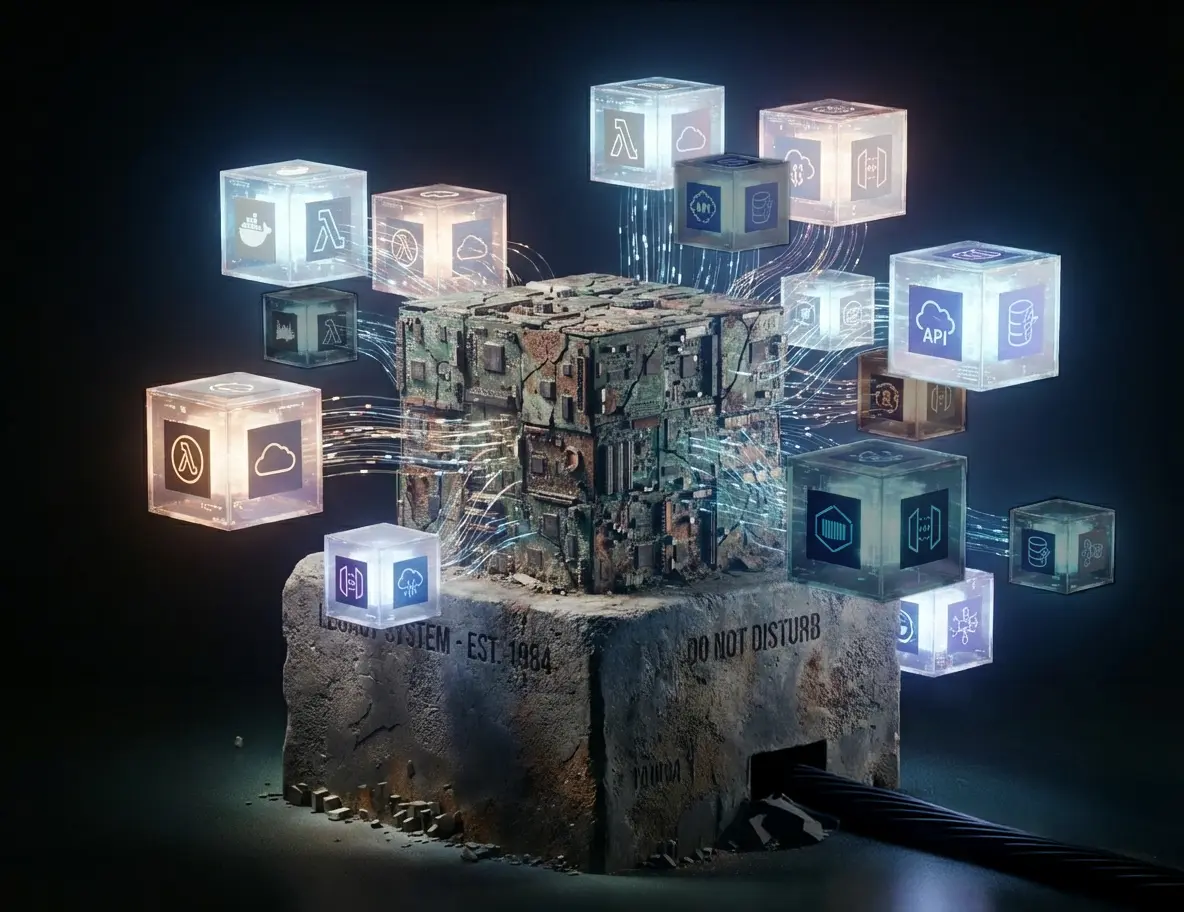

Why "All-at-Once" Fails
Replacing old systems entirely at once has proven to be one of the most high-risk operational models for IT projects.
According to Standish Group's CHAOS reports, large IT renewals implemented all at once exceed their budgets and schedules significantly more often than projects that proceed in phases.
The problem is not in technology but in scale: when critical operations, data, and users are moved simultaneously, errors compound and there is no way back.
Watch more about how Gentle Exit works

When does a system enter the risk zone?
A system is at the end of its lifecycle when support ends, expertise relies on just one or two people, changes take weeks, or no one knows all the integrations.
If this sounds familiar, download the brochure →The Managed Transition Model: Gentle Exit
The new system grows around the old one and takes over functions one at a time. A protective layer built around the legacy system directs traffic between old and new seamlessly.
This enables the development of new services that were previously hindered by the limitations of the old system.

Built-in Risk Management

Lightweight and Stateless
The new layer is lightweight and stateless - it does not store data permanently, which minimizes security risks.
Example Implementation: Form Interpreter →
API Facade
An API facade protects the old system and directs traffic seamlessly between the old and the new.

Analysis-First
Modern analysis tools reveal the hidden logic of the legacy system and facilitate the transition.
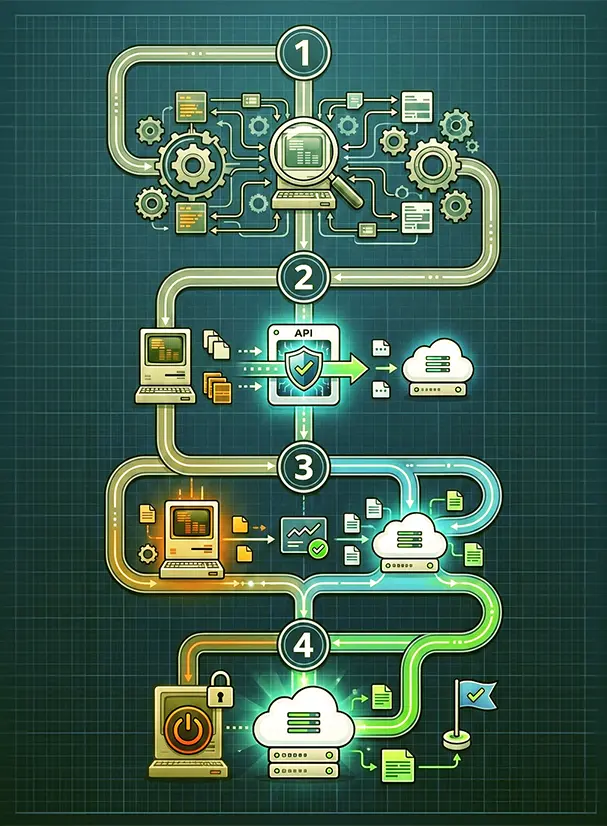
Progress Without Disruption
-
1
Interface Mapping
First, dependencies and data flows are identified across the ecosystem to understand what the system is actually used for.
-
2
Protective Layer
A protective API layer is built, allowing individual low-risk functions to be moved to the new environment without impacting legacy.
-
3
Parallel Run
Old and new operate side-by-side, allowing performance and results to be validated with real production traffic before decisions.
-
4
Safe Decommission
The legacy system is shut down only when the new solution has proven its functionality and there is no real use for the old one.
Not Just an IT Project
Gentle Exit is a managed transition model that supports digitalization without downtime or forced system renewals. New is built alongside old, step-by-step.
As progress occurs with limited and low-risk functionalities, the entity is well-suited for grant funding. Development can proceed without a lump-sum investment.
The Gentle Exit model can be implemented in cooperation with Digiter ry. Digiter is a non-profit association, enabling development within public and EU funding.
For many organizations, Gentle Exit is not an additional cost, but a way to shift existing maintenance and risk costs towards managed and transparent development.
System Assessment
Interactive tool to help identify legacy system risks, dependencies, and business impacts for controlled decommission. View example assessment (Finnish).
The next step is not a commitment
Managed decommission begins with understanding risk, not shutting down the system.
Privacy: Assessment answers are processed during service requests, and a resume code can be stored in your browser for continuation. We do not persist assessment progress in a separate server-side database. When you submit this form, your provided information is delivered to an expert mailbox by email.

Lightening the Digital Burden
Digiter ry is a non-profit association at the core of which is the facilitation of digitalization and the design of solutions that genuinely serve people. Digiter’s work focuses on situations where digital services, language, or system complexity form barriers to daily life.
Gentle Exit is a key development project for Digiter, as it enables municipalities, organizations, and communities to develop new digital services by utilizing existing systems, experience, and accumulated data – without having to dismantle or replace functional structures at once.
Digiter's work starts from people and real-life situations. The video tells why the task of digitalization is not to make life difficult – but to enable it.
Digiter develops solutions and operating models in cooperation with projects, municipalities, and other societal actors also internationally. Work is done non-profitably so that development is genuinely accessible and applicable to the needs of the public sector.
A good example of Digiter's operating method is the Form Interpreter, a service that helps people understand official forms and decisions in clear language. The service is built with respect for privacy and anonymity: data is not stored, and no user profiles are created.
The same principles guide the development of Gentle Exit.